Reviews
How to audit influencer agency reviews before you trust a review site rating
Audit influencer agency reviews by checking the reviewer, scope, date, evidence, incentive and response, then testing themes against contracts and references.
What to take away
- A high rating on Clutch, G2 or Trustpilot is a lead about an influencer agency, not proof of fit.
- Check the reviewer, the work, the date and any payment behind a review.
- Test review themes against contracts, campaign records and reference calls.
- The FTC rule covers fake reviews, conditional incentives and suppression of negatives.
Review sources that list influencer agencies
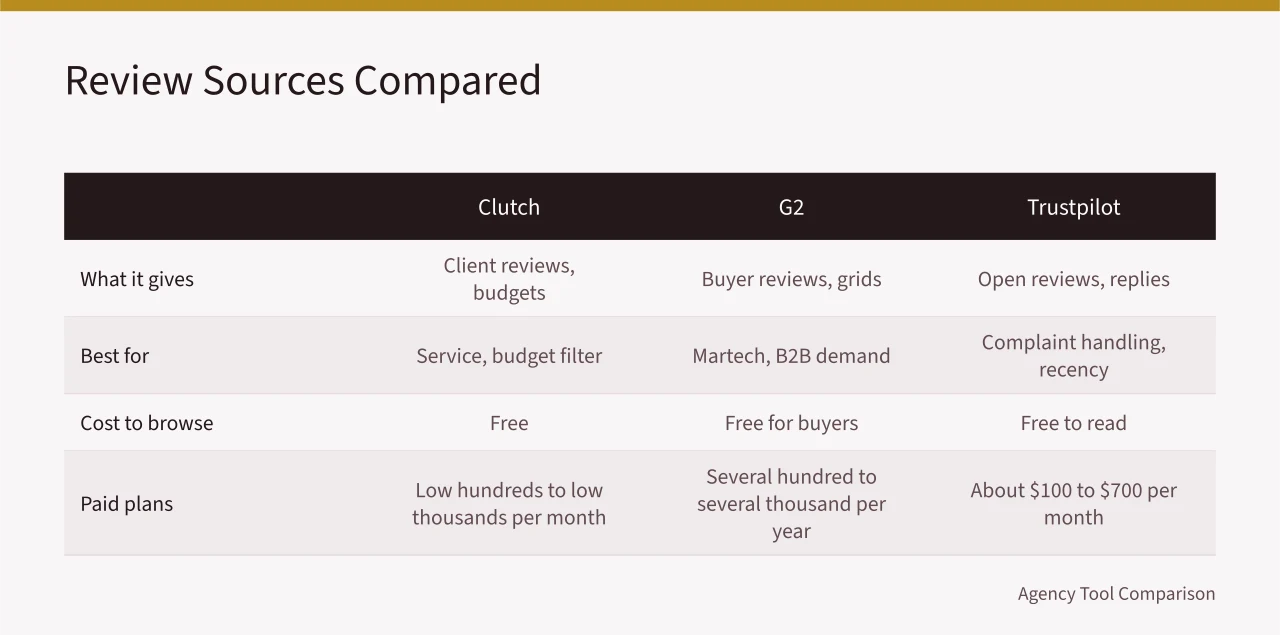
Influencer agencies share review sites with general advertising shops, so the two blur together. Clutch and The Manifest publish client reviews with project budgets. Costs quoted beside those listings vary, and influencer agency and platform pricing explained line by line sets out what each fee buys.
| Source | What it shows about an influencer agency | How to use it |
|---|---|---|
| Clutch | Client reviews, minimum spends, hourly rates, office city | Filter by creator marketing, budget and client type |
| The Manifest | Short profiles and campaign examples | Cross-check Clutch themes |
| G2 | Buyer scores and comparison grids | Compare platforms and agencies selling to B2B teams |
| Trustpilot | Open reviews and business replies | Read how a complaint was handled |
| Better Business Bureau | Complaints and accreditation status | Look for dispute patterns |
None of this proves fit on its own. Clutch and DesignRush sell sponsored placement, so a top slot can reflect spending. Budget figures are self-reported and rounded, which makes them ranges rather than facts.
What the FTC rule requires of influencer agencies
The FTC's Consumer Reviews and Testimonials Rule bars fake reviews, insider reviews dressed as independent ones, conditional incentives and review suppression. An agency and a platform can both carry liability.
The FTC's guidance on social media influencer disclosures covers the adjacent duty. Paid creator posts must be labeled, and the agency that writes the brief shares that responsibility.
Because agencies draft disclosure language into creator contracts, a review of those contracts sits close to a review of the agency. How US agencies put FTC endorsement rules into creator contracts and briefs lists the clauses worth requesting.
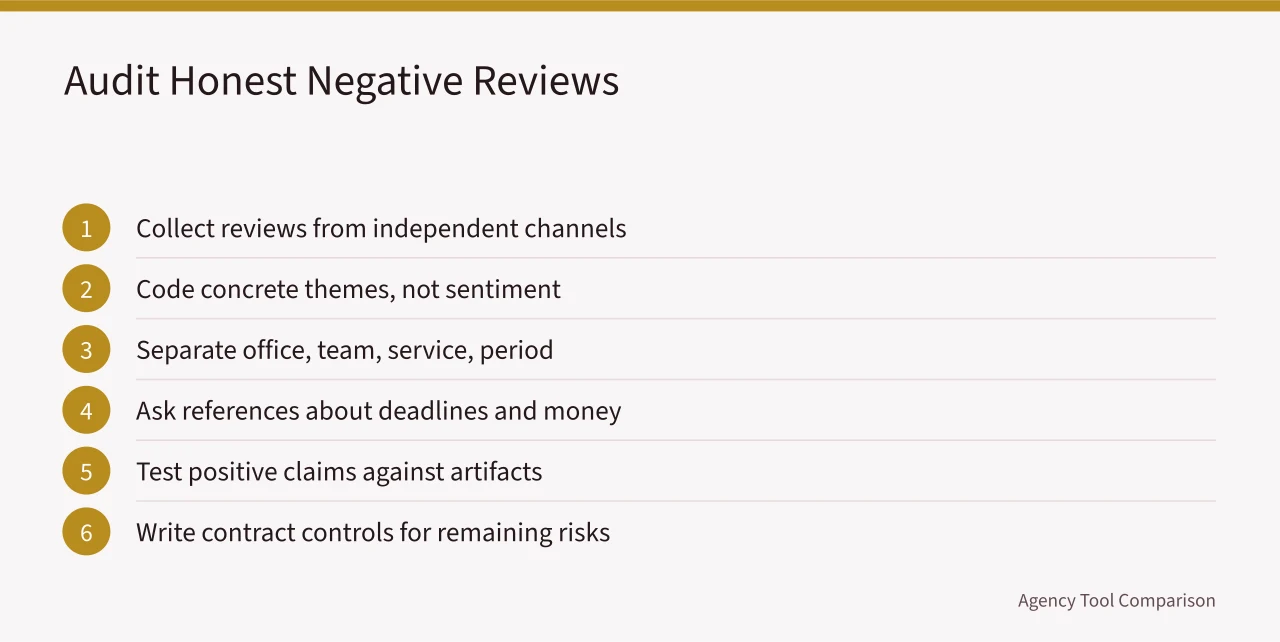
How to audit an influencer agency review
Separate the agency from the office, the team and the year. A talent management division and a paid media division can share a letterhead and nothing else.
- Revieweris the person and company relationship credible, and can you confirm the role?
- Scopewhich service, market, budget and team did the work involve?
- Datedid the work involve people who are still at the agency?
- Evidencedoes the review name conduct or results you can observe?
- Incentivewas access, credit or money tied to the review?
- Patterndoes the same complaint appear on a second independent source?
- Responsedid the agency address facts and correct errors?
Screen for bursts of reviews in one week, repeated phrasing and reviewers with no other history.
If your agency sits inside a holding company, the platform may already be chosen above your level. How US agency holding companies run procurement for influencer platforms explains why your rate card rarely matches a negotiated group deal.
Example: reading a five-star Clutch profile
An influencer agency shows 42 reviews and a 4.8 average. Six arrived in one week, and four reuse the same phrase about flawless execution.
Three reviewers list titles at companies that never appear in the agency's public case studies. None of that proves fraud. It tells you to request campaign briefs, reporting cadence and the names of account leads.
Ask which clients left, and why. Ask for two references from the past 18 months where work slipped, then for the corrected invoices or reports that followed. A spotless reference call usually means the questions were too easy.
Los Angeles and New York agencies staff creator campaigns differently, and why Los Angeles and New York agencies buy different influencer tools covers that split. Read reviews from the office that would actually run your account.
Commissions, contracts and platform fees
Talent agencies that book creator work usually take a percentage, and state law constrains the practice. California limits what a talent agency may collect from a client.
Cornell's definition of agency and fiduciary duties gives the standard an agent owes a principal, which fits an influencer agency too. A registered talent agent files a contract and posts a bond.
Platforms bill by subscription, by a share of ad spend, or both. Read the invoice before you compare two quotes.